"A Poor Imitation Of A Fourth"
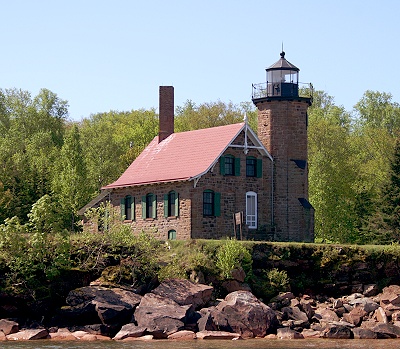
Sand Island Lighthouse
Taking pen in hand one Fourth of July, a teenage girl set down
her complaint: her holiday had been boring.
What sets this particular lament apart from more typical cases of
youthful angst are the circumstances: the writer was the young bride
of a lighthouse keeper on a Lake Superior Island, and she was writing
not in her diary, but in the station logbook. Referring to her
attempts at festivity in company with a houseguest, she lamented:
July 4, 1899... After attending to the lamps and the housework
Emma and I proceeds (sic) to celebrate by firing off some
firecrackers and torpedoes and having as good a time as was possible.
The best however is a very poor imitation of a "Fourth."
A modern reader can understand her frustration. Ella Richardson
was only sixteen years old when she married lighthouse keeper
Emmanuel Luick, thirteen years her senior. A city girl from the east,
she left friends and family to follow her husband to Sand Island in
the Apostle Islands chain. One pictures a restless teenager, eager
for excitement and change in her life, smitten by the attentions of a
dashing older man with tales of romantic wilderness life.
Instead, she found routine and boredom; isolation and
loneliness.
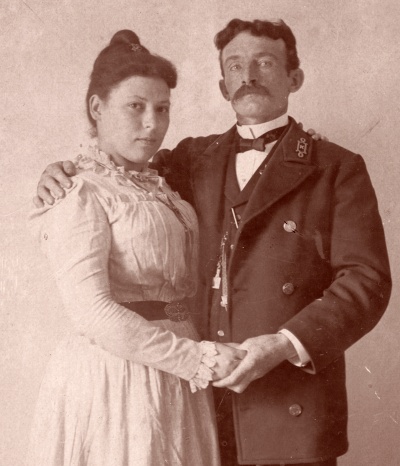
Ella and Emmanuel Luick
at their wedding, 1895
But Ella Luick was by no means the only lighthouse occupant to
comment on a dreary Independence Day.
Contemporary readers might find it difficult to appreciate the
importance of the Fourth of July holiday a century ago. In an era
before the widespread forty-hour workweek, the break from daily labor
was especially welcome; and without the ubiquitous diversions
provided by television and the Internet, holiday celebrations seemed
far more exciting. Some observers go so far as to say that Americans
had more patriotic fervor in those days, as well.
Whatever the reason, the Glorious Fourth of July was one of the
most important days of the year. The Fourth was a day for speeches
and parades, for picnics and family celebrations, for band concerts
and fireworks displays.
Very little excitement of that sort was to be found on an island
in Lake Superior, and it seems that many lighthouse keepers felt the
isolation of their surroundings especially oppressive on Independence
Day.
Flipping through the logbook of the LaPointe light station on
Long Island, for example, one finds many holiday entries that paint a
similar picture to Ella's lament:
1894 July 4: A fine day for the Fourth but lonesome.
1901 July 4: Run signal from 2 A.M. 'til 11:30 A.M. Dull
Fourth.
1904 July 4: This has been a very lonesome day. No fireworks
and not much to eat. Waiting to get to town.
1906 July 4: Nothing done today. Keep the Fourth but very
quiet.
Surely, one entry was written specifically to make a point:
1942 July 4: Independence Day. Cleaned out grease trap.
Meanwhile, the keeper at Outer Island noted in 1900,
July 4: Rain, thunder, and lightning at night, and fog at 11:15
PM. Keeping the Fourth by flying Old Glory. That was about all we
could do.
And two years later complained,
1902 July 4: Cleaning, trimming Lamps and Lens. Tending Fog
Signal. Inspected the Station. A very dreary day for the Glorious
Forth.
Then,
1906 July 4: Cleaning, trimming Lamps and Lens. Put Old Glory up
to the breeze as that was about all I could do to celebrate.
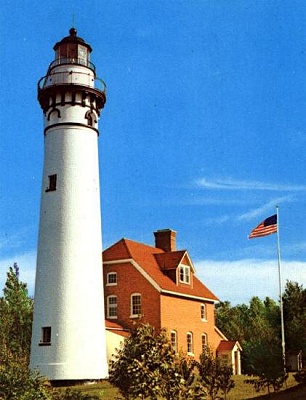
Old Glory at Outer Island, 1974
We get the point. Even the stoic and studious Francis Jacker
seemed to feel the isolation of Raspberry Island when Independence
Day rolled around:
07/04/87 Rain on the Fourth. No celebration within twelve miles
of the station. The day was passed in quiet solitude, as usual.
One of his successors at least managed a bit of irony:
7/4/12 Calm and clear. Been a safe and sane Fourth of July on
the Island.
Ella Luick finally found a way to escape the boredom of
lighthouse life. On a May afternoon in 1905, after ten years of
increasingly unhappy marriage, she boarded a steamer and left Sand
Island and Emmanuel Luick for good. At the age of only 26, she surely
had many Independence Days remaining in her future. Let's hope they
were more satisfying than that "poor imitation" in 1899.
|